
Traditional budgeting advice assumes a predictable paycheck landing on the same date every month. For freelancers, gig workers, and anyone paid on commission or variable hours, that assumption simply does not match reality. One month might bring in $6,000, and the next only $2,000, making standard percentage-based budgets feel almost impossible to apply consistently.
The good news is that irregular income can absolutely be budgeted for effectively. It just requires a different structure, one built around your lowest realistic income rather than an average that might not materialize in any given month. Here is exactly how to build that system.
Why Standard Budgeting Advice Falls Short for Irregular Income
Most budgeting guidance assumes you know exactly what is coming in each month, allowing you to plan fixed percentages toward needs, wants, and savings. With irregular income, this creates two recurring problems.
Overspending during high-income months. Without a specific plan, a particularly good month often leads to increased spending that is difficult to scale back down once the next lower-income month arrives.
Panic during low-income months. Without a buffer or a plan built around your lowest realistic income, an inevitable slow month feels like a crisis rather than an anticipated, manageable part of the income pattern.
The solution is to stop budgeting off your average income and start budgeting off your lowest reasonably expected income instead.
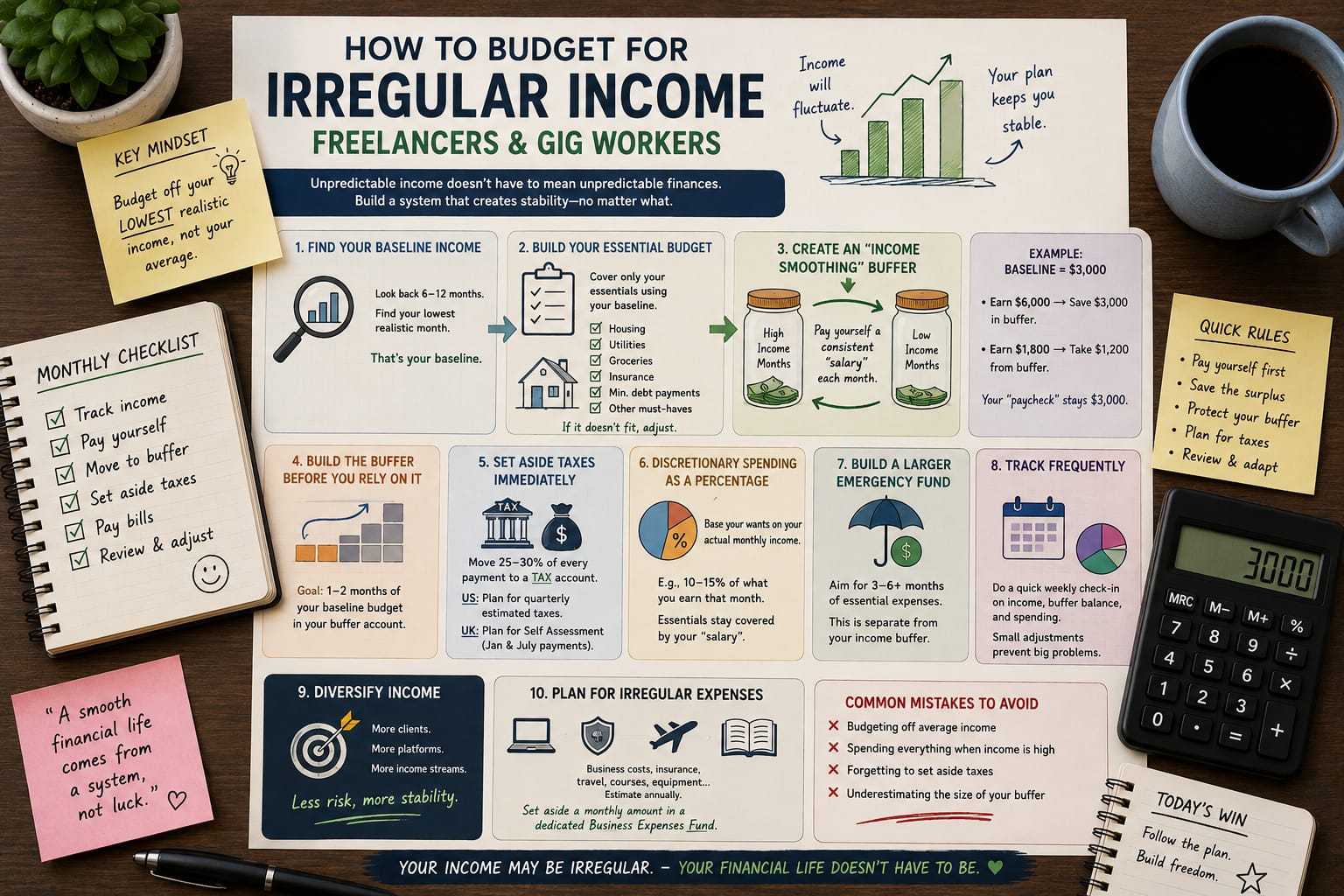
Step 1: Calculate Your Baseline Income
Look back over the last six to twelve months of income and identify your lowest earning month, excluding any truly unusual one-off circumstances like an extended illness or a rare dry spell unlikely to repeat. This lowest realistic figure becomes your baseline for essential budgeting purposes.
If you are new to freelancing or gig work and do not have historical data yet, be conservative. Estimate on the lower end of what you expect, and adjust as you gather real data over your first few months.
Step 2: Build Your Essential Budget Around the Baseline
Using your baseline income figure, build a budget covering only essential expenses: rent or mortgage, utilities, groceries, minimum debt payments, insurance, and other non-negotiable costs. If your baseline income covers these essentials with some room to spare, you have a workable foundation. If it does not, this is important information, signaling either a need to reduce essential costs, increase your income floor, or build a larger buffer to bridge future gaps.
Step 3: Create an “Income Smoothing” Buffer Account
This is the single most important structural tool for irregular income, and it works differently from a traditional emergency fund. Open a separate account specifically to smooth out the peaks and valleys of your income.
Here is how it works: every month, pay yourself a consistent “salary” from this account, based on your baseline figure, regardless of how much you actually earned that month. Any income above your baseline in a strong month goes into this buffer account rather than being spent immediately. In a weaker month, you draw from the buffer to maintain that same consistent personal “paycheck.”
This effectively transforms irregular income into something that behaves like a stable salary from your day-to-day budgeting perspective, even though the underlying income remains variable.
Step 4: Build the Buffer Before Relying On It
If you are just starting this system, you will need to build up the income smoothing buffer before it can reliably support you through a low month. Aim for at least one to two months of your baseline budget in this account before fully relying on it to smooth your income. Until then, continue tracking your actual income closely and being conservative with discretionary spending during any higher-earning months.
Step 5: Separate Taxes Immediately (Critical for the US and UK)
One of the most common and damaging mistakes among freelancers and gig workers is failing to set aside money for taxes as income arrives, leading to a painful, sometimes unaffordable tax bill later.
The moment any payment arrives, immediately transfer a set percentage, commonly 25-30% depending on your specific tax bracket, business structure, and location, into a separate savings account earmarked exclusively for taxes. Treat this money as if it does not belong to you at all; it is simply passing through your account on its way to the tax authority.
In the US, this often means setting aside money for quarterly estimated tax payments. In the UK, self-employed individuals typically need to plan for Self Assessment tax payments, often due in January and July. Consulting an accountant familiar with your specific situation is worthwhile, since exact percentages and requirements vary considerably based on income level and structure.
Step 6: Categorize Discretionary Spending as a Percentage, Not a Fixed Amount
While essential expenses should be based on your baseline income, discretionary spending, like entertainment, dining out, and non-essential shopping, can reasonably be tied to a percentage of whatever you actually earn in a given month, since these categories have natural flexibility built in already.
This means a strong income month naturally allows for somewhat more discretionary spending, while a weaker month naturally requires more restraint, all without disrupting your essential expenses, which remain covered by your consistent “salary” from the buffer account.
Step 7: Build a Larger Emergency Fund Than Traditional Advice Suggests
Traditional guidance often recommends three to six months of expenses for an emergency fund. For irregular income earners, aiming toward the higher end of this range, or even beyond it, provides meaningfully more security, given the added unpredictability of income itself on top of the usual risks like job loss or medical emergencies that everyone faces.
This fund should be separate from your income smoothing buffer described earlier. The emergency fund covers genuine emergencies; the smoothing buffer covers the normal, expected variability of irregular income itself.
Step 8: Track Income and Expenses More Frequently Than Monthly
Given the added variability involved, a monthly-only review cycle can sometimes let problems compound before they are noticed. Consider a brief weekly check-in specifically looking at: how much came in this week, how the smoothing buffer balance is trending, and whether any adjustments are needed to discretionary spending for the remainder of the month.
This more frequent rhythm catches issues, like a slower month than expected, early enough to adjust calmly rather than discovering a serious shortfall only at month’s end.
Step 9: Diversify Income Sources Where Possible
For freelancers and gig workers specifically, income stability often improves considerably by diversifying across multiple clients, platforms, or income streams, rather than relying heavily on a single source that could disappear unexpectedly. This is not purely a budgeting tactic, but it directly supports the predictability that makes the entire budgeting system described here work more smoothly.
Step 10: Plan for Irregular Business and Personal Expenses Separately
Beyond personal budgeting, freelancers and gig workers often have business-related irregular expenses too: equipment replacement, software subscriptions, insurance, or professional development costs. Treat these similarly to personal irregular expenses, estimating an annual total and setting aside a consistent monthly amount in a dedicated business expense fund, rather than letting them arrive as unexpected costs that disrupt your broader financial plan.
Common Mistakes to Avoid With Irregular Income
Budgeting off average income rather than baseline income. Averages can be misleading, since a few unusually strong months can inflate the average well above what is realistic to expect consistently.
Spending immediately when a large payment arrives. Without the income smoothing system in place, a strong month often leads to spending that cannot be sustained once income returns to a more typical level.
Neglecting to separate taxes as income arrives. This is one of the most financially damaging mistakes for self-employed individuals, often resulting in a large, stressful tax bill that could have been avoided with consistent, immediate set-asides.
Underestimating how large a buffer is genuinely needed. Irregular income often requires a larger safety net than steady employment, given the added layer of unpredictability on top of normal financial risks.
Final Thoughts
Budgeting for irregular income requires a fundamentally different structure than traditional paycheck-based advice, but it is entirely manageable with the right system. Building your essential budget around your lowest realistic income, creating an income smoothing buffer to pay yourself a consistent “salary,” separating taxes immediately as income arrives, and maintaining a larger emergency fund all work together to create genuine financial stability, even when the underlying income itself remains variable month to month.
The goal is to make your day-to-day financial experience feel steady and predictable, regardless of how unpredictable your actual income might be behind the scenes.
Frequently Asked Questions
How much should I set aside for taxes as a freelancer? A common starting guideline is 25-30% of each payment, though the exact percentage depends on your income level, tax bracket, and business structure. Consulting an accountant for your specific situation is strongly recommended.
What is an income smoothing buffer, and how is it different from an emergency fund? An income smoothing buffer absorbs the normal variability of irregular income, allowing you to pay yourself a consistent monthly amount regardless of what you actually earned. An emergency fund is separate and covers genuine unexpected emergencies beyond normal income fluctuation.
Should freelancers have a bigger emergency fund than traditionally employed people? Many financial guides suggest aiming toward the higher end of the typical three-to-six-month range, or beyond, given the added unpredictability that comes with irregular income on top of standard financial risks.
How often should irregular income earners review their budget? A weekly review is often more effective than a purely monthly one, allowing quicker adjustments to discretionary spending based on how the month’s income is actually trending.
How to Budget for Irregular Income (Freelancers & Gig Workers)





Leave a Reply