

to cut everything enjoyable: no more dining out, no more streaming, no more small treats. This approach rarely lasts, because it treats every expense as equally expendable, regardless of how much genuine value it provides.
A smarter approach targets the expenses that cost the most relative to the value they actually deliver, while protecting the ones that genuinely matter to your quality of life. Here is a complete, practical framework for cutting monthly expenses in a way that actually sticks.
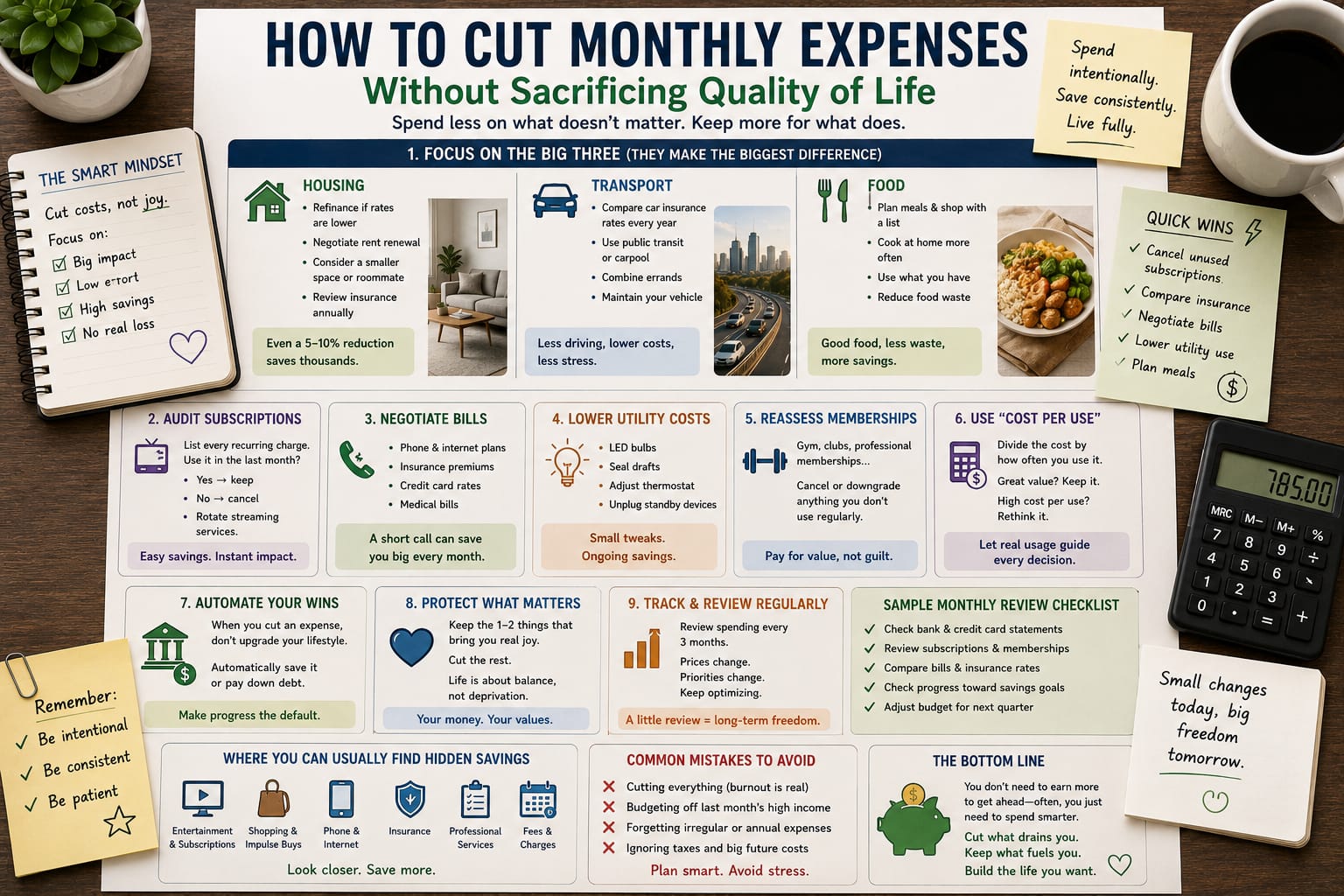
Start With the Big Three: Housing, Transport, and Food
These three categories typically account for 60-70% of most household budgets, meaning even modest reductions here have a far larger impact than aggressively cutting smaller discretionary categories.
Housing
Housing is usually the single largest expense, and while it is not always easy to change quickly, a few strategies are worth genuinely considering:
Refinancing a mortgage if interest rates have dropped meaningfully since you took yours out, which can reduce monthly payments significantly over the life of the loan.
Negotiating rent renewal, particularly if you have been a reliable tenant, since many landlords prefer a small discount over the cost and uncertainty of finding a new tenant.
Considering a roommate or a smaller space if your current housing situation exceeds what you genuinely need, particularly if flexibility exists.
Reviewing homeowners or renters insurance annually, since rates and available discounts change frequently, and loyalty rarely results in the best available rate.
Transport
Compare car insurance rates annually rather than automatically renewing, since switching providers periodically often reveals meaningful savings for identical or similar coverage.
Consider whether you need a second car if household circumstances have changed, given the combined cost of payments, insurance, fuel, and maintenance for an additional vehicle.
Combine errands into fewer trips and consider public transport or carpooling for regular commutes where genuinely feasible.
Stay current on vehicle maintenance, since minor, regular upkeep is almost always cheaper than the larger repairs that result from deferred maintenance.
Food
Plan meals around what is already in your kitchen and what is on sale, rather than deciding on meals first and buying whatever they require regardless of price.
Reduce food waste through realistic portion planning and deliberate use of leftovers, since wasted food is effectively wasted money.
Limit takeaway and food delivery, which typically carries a significant price premium, reserving it for occasions where it genuinely adds value rather than pure convenience.
Compare store-brand alternatives for staple items, where quality differences are often minimal compared to the price difference.
Audit Recurring Subscriptions Thoroughly
Subscription costs are one of the easiest categories to reduce without any real sacrifice, precisely because many subscriptions go unused or underused without anyone noticing for months.
Go through your bank statement and list every recurring charge: streaming services, apps, gym memberships, subscription boxes, and similar services. For each one, ask honestly: have I used this meaningfully in the last month? Cancel anything that fails this test.
Consider rotating streaming subscriptions rather than paying for several simultaneously, subscribing to one service for a focused month of viewing, then switching to the next rather than paying for all of them year-round.
Negotiate Bills You Assume Are Fixed
Many recurring bills are more negotiable than most people realize, and a short phone call can often result in genuine savings without any change to the actual service received.
Phone and internet plans often have better rates available that existing customers do not automatically receive, particularly if you mention considering a switch to a competitor.
Insurance premiums, across car, home, and where applicable health insurance, should be compared periodically rather than automatically renewed each year.
Credit card interest rates can sometimes be reduced simply by calling and asking, particularly if you have a solid payment history with that provider.
Medical bills, particularly in the US, can sometimes be negotiated directly with providers, especially for larger, unexpected costs, and many providers offer payment plans or discounts for paying in full.
Reduce Energy and Utility Costs
Small, often one-time changes to how your home uses energy can create ongoing monthly savings without any real change to daily comfort or convenience:
Switch to energy-efficient light bulbs if you have not already, since the modest upfront cost typically pays back within months through reduced electricity use.
Seal drafts around windows and doors, which can meaningfully reduce heating and cooling costs in many homes.
Adjust thermostat settings slightly, even a degree or two, particularly overnight or when the home is empty during the day, which can add up to meaningful savings over a full year.
Unplug or use a power strip for devices that draw standby power when not actively in use.
Reassess Memberships and Services You No Longer Fully Use
Beyond digital subscriptions, physical memberships often continue well past the point of genuine regular use: gym memberships attended once a month, professional memberships no longer relevant to your current role, or club memberships that no longer align with current interests.
Review these annually and honestly assess whether the cost still matches the value received. If not, cancel or downgrade to a lower-cost tier that better matches actual usage.
Use the “Cost Per Use” Mindset for Bigger Decisions
For larger recurring costs, it can help to think in terms of cost per actual use rather than the monthly or annual price alone. A $50 monthly gym membership used four times a week works out to roughly $3 per visit, which is excellent value. The same membership used once a month works out to $50 per visit, which is a much harder cost to justify.
This mindset shift helps identify which expenses are genuinely worth keeping, based on real usage patterns, versus which ones simply carry an ongoing cost with diminishing actual value.
Automate Savings From Any Reductions You Make
When you successfully reduce a recurring expense, whether through negotiation, cancellation, or a genuine lifestyle adjustment, immediately redirect that freed-up money into an automatic savings transfer or extra debt payment, rather than letting it quietly absorb back into general spending.
This single habit ensures that the effort put into cutting expenses translates into real, lasting financial progress, rather than simply shifting spending toward a different, unplanned category.
Protect What Genuinely Matters to You
The entire point of cutting expenses without sacrificing quality of life is being selective, not eliminating everything discretionary indiscriminately. Identify the one or two categories that provide genuine, meaningful value to you personally, whether that is a particular hobby, occasional dining out with people you care about, or a specific subscription you use extensively, and protect these deliberately, even as you cut aggressively elsewhere.
A budget that eliminates every source of enjoyment tends to collapse eventually, often in a burst of frustrated overspending after a period of feeling deprived. Selective, values-based cutting is far more sustainable long-term.
Review Your Progress Regularly
Set a recurring reminder, perhaps quarterly, to review your recurring expenses again. Prices increase over time, new subscriptions accumulate, and circumstances change, meaning a one-time review is rarely enough to keep expenses genuinely optimized over the long run.
Final Thoughts
Cutting monthly expenses without sacrificing quality of life comes down to being deliberate rather than indiscriminate. Focus first on the largest categories, housing, transport, and food, where even modest reductions have an outsized impact, then move through subscriptions, negotiable bills, and utility costs, all while deliberately protecting the specific expenses that provide genuine, meaningful value to your life.
Done well, this approach frees up real money for savings, debt repayment, or other goals, without the sense of constant restriction that makes so many cost-cutting efforts collapse within a few months.
Frequently Asked Questions
What is the fastest way to reduce monthly expenses? Reviewing and negotiating large fixed costs, such as insurance, phone plans, and housing-related expenses, typically frees up more money with less ongoing effort than cutting many small discretionary purchases.
Should I cancel all my subscriptions to save money? Not necessarily. Cancel subscriptions you have not used meaningfully in the last month, but keep ones that provide genuine, regular value, since sustainable cost-cutting is about selectivity, not elimination.
How often should I review my recurring expenses? A quarterly review is a reasonable habit, since prices and usage patterns change over time, meaning a one-time review is rarely sufficient to keep expenses genuinely optimized long-term.
Is it worth negotiating bills I assume are fixed? Yes. Many providers, including insurance companies, phone and internet providers, and even some credit card issuers, offer better rates to customers who simply ask, particularly when mentioning a potential switch to a competitor.
How to Cut Monthly Expenses Without Sacrificing Quality of Life


Leave a Reply