

Few numbers carry as much quiet influence over your financial life as your credit score. It affects whether you get approved for a mortgage, what interest rate you pay on a car loan, whether a landlord accepts your rental application, and sometimes even certain job or insurance decisions. Yet many people have only a vague idea of how it actually works.
This guide breaks down exactly what makes up a credit score, why it matters, and the specific, practical steps that genuinely move the number in the right direction, whether you are in the US or UK.
What a Credit Score Actually Represents
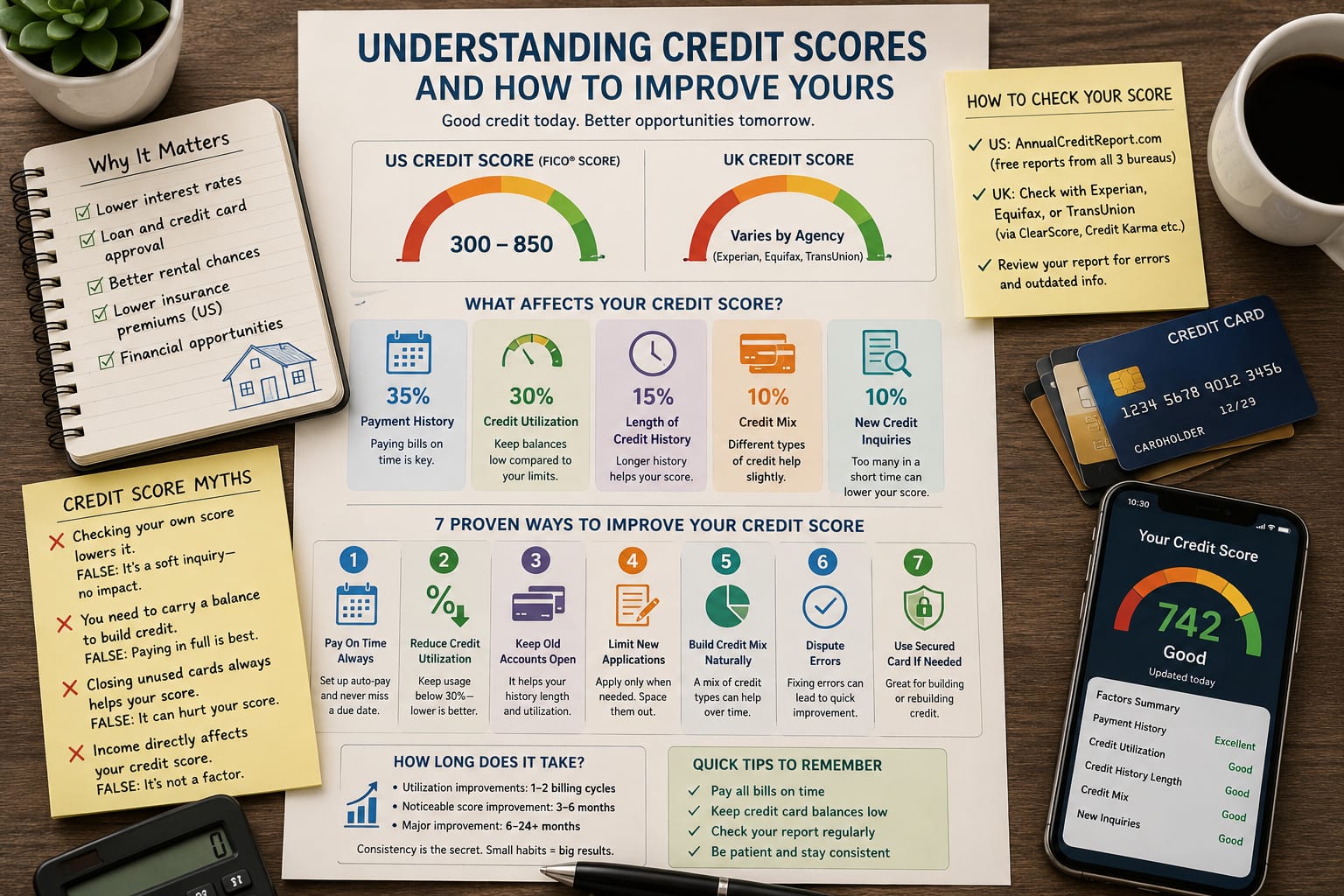
A credit score is a numerical summary of how reliably you have managed borrowed money in the past, used by lenders to estimate the risk of lending to you in the future. In the US, scores typically range from 300 to 850, using models like FICO and VantageScore. In the UK, credit reference agencies like Experian, Equifax, and TransUnion each use their own scoring ranges, though the underlying principles are similar.
A higher score signals to lenders that you have a track record of managing credit responsibly, which typically translates into easier approvals and better interest rates. A lower score suggests higher risk from a lender’s perspective, often resulting in higher interest rates, required deposits, or outright rejection for certain products.
The Main Factors That Determine Your Credit Score
While exact formulas vary between scoring models and countries, most credit scores are built from a similar set of core factors.
Payment history (the single biggest factor). Whether you have paid past credit accounts on time is typically the most heavily weighted factor in most scoring models. Even one missed or significantly late payment can meaningfully affect your score, and the impact tends to be more severe the more recent and more overdue the missed payment was.
Credit utilization. This refers to how much of your available credit you are currently using, particularly on revolving credit like credit cards. Using a smaller percentage of your available limit generally supports a higher score, while consistently maxing out available credit tends to lower it, even if payments are always made on time.
Length of credit history. A longer track record of managing credit generally supports a higher score, since it gives lenders more data to assess reliability. This is part of why closing old credit accounts, even ones you rarely use, can sometimes lower your score by shortening your average account age.
Credit mix. Having experience managing different types of credit, such as a mix of credit cards, a car loan, or a mortgage, can have a modest positive effect, since it demonstrates the ability to manage varied credit responsibly. This factor typically carries much less weight than payment history or utilization.
New credit inquiries. Applying for several new credit accounts within a short period can temporarily lower your score slightly, since it may suggest increased risk or financial strain, though a single inquiry usually has only a small, short-lived impact.
Why Your Credit Score Matters Beyond Loan Approval
Credit scores influence more areas of financial life than many people realize.
Interest rates on mortgages, car loans, and personal loans are often directly tied to credit score ranges, meaning even a moderate improvement can save thousands over the life of a loan.
Credit card approval and terms, including your credit limit and any rewards eligibility, are heavily influenced by your score.
Rental applications in many markets include a credit check as part of the approval process, particularly in competitive rental markets.
Certain insurance premiums, particularly in the US, can be influenced by credit-based insurance scores in some states.
Utility and phone contracts sometimes use credit checks to determine whether a deposit is required for new service.
How to Check Your Credit Score and Report
Before working on improvement, it helps to know your current starting point. In the US, you are entitled to a free credit report from each of the three major bureaus (Equifax, Experian, and TransUnion) through the official government-authorized website. In the UK, Experian, Equifax, and TransUnion (via services like ClearScore or Credit Karma) offer free access to your credit report and score.
Review your report carefully for any errors, such as accounts that are not yours, incorrect late payment records, or outdated information that should have been removed. Errors are more common than most people expect and can meaningfully drag down an otherwise healthy score if left uncorrected.
Step-by-Step: How to Improve Your Credit Score
- Make Every Payment On Time, Every Time
Since payment history typically carries the most weight in most scoring models, this is the single most impactful habit you can build. Set up automatic minimum payments on all credit accounts to eliminate the risk of an accidental missed payment, even during a busy or forgetful month.
If you have missed payments in the past, the negative impact naturally fades over time as more positive, on-time payment history accumulates, so consistency going forward matters more than dwelling on past mistakes. - Reduce Your Credit Utilization
Aim to keep your credit card balances well below your total available limit, ideally under 30%, and even lower if possible for the strongest impact. If you have a $5,000 combined credit limit, this means keeping your combined balance below roughly $1,500 at any given time that gets reported to credit bureaus.
Paying down balances before the statement closing date, rather than just before the payment due date, can help lower the utilization figure that actually gets reported, since many card issuers report your balance as of the statement date rather than after you have made a payment. - Avoid Closing Old Credit Accounts Unnecessarily
Even if you rarely use an older credit card, keeping it open (particularly if it has no annual fee) can support a longer average credit history and a lower overall utilization ratio, both of which support a healthier score. Closing old accounts can sometimes have a counterintuitive negative effect on your score for these reasons. - Limit New Credit Applications
Space out applications for new credit and only apply when genuinely needed, since multiple inquiries within a short window can have a compounding, though typically modest, negative effect on your score. This matters particularly in the months leading up to a major application, like a mortgage, where you want your score in the best possible position. - Diversify Your Credit Mix Naturally Over Time
While you should never take on debt you do not need purely to “improve credit mix,” naturally building a track record across different types of credit over time, such as a credit card alongside a car loan or student loan, can provide a modest positive contribution to your overall score. - Dispute Any Errors on Your Credit Report
If you find inaccurate information on your credit report, whether an account that is not yours, an incorrectly reported late payment, or outdated negative information that should have aged off your report, formally dispute it with the relevant credit bureau. Corrections can sometimes result in a meaningful score improvement, particularly if the error was significant. - Consider a Secured Credit Card If Building Credit From Scratch
For those with no credit history or a significantly damaged one, a secured credit card, which requires a cash deposit that typically becomes your credit limit, can be an effective way to build or rebuild credit through consistent, on-time payments and low utilization over several months.
How Long Does It Take to Improve a Credit Score?
Timelines vary considerably depending on your starting point and the specific issues affecting your score. Reducing high credit utilization can show noticeable improvement within one to two billing cycles, since this factor updates relatively quickly. Building a longer positive payment history and repairing the impact of past missed payments, however, typically takes many months to a few years of consistent, positive credit behavior.
Patience and consistency matter more than any single dramatic action. There is no legitimate way to instantly repair a damaged score; genuine improvement comes from sustained, responsible credit behavior over time.
Common Credit Score Myths
“Checking your own credit score lowers it.” Checking your own score or report is considered a “soft inquiry” and has no impact on your score, regardless of how often you check.
“You need to carry a balance on your credit card to build credit.” Paying your full balance every month builds credit just as effectively, if not more so, than carrying a balance, and avoids unnecessary interest charges entirely.
“Closing unused credit cards always helps your score.” This can actually hurt your score by reducing your available credit (increasing utilization) and shortening your average account age.
“Your income directly affects your credit score.” Income itself is not a factor in credit scoring models, though it can influence lending decisions and credit limits separately from the score itself.
Final Thoughts
Understanding your credit score removes much of the mystery around one of the most influential numbers in personal finance. It is built primarily from your payment history and credit utilization, with smaller contributions from credit history length, credit mix, and recent applications. Improving it is rarely about a single dramatic action; it is about consistent, responsible habits sustained over months and years: paying on time, keeping balances low relative to your limits, and avoiding unnecessary new credit applications.
Check your credit report regularly for errors, be patient with the timeline, and treat your credit score as a long-term reflection of consistent financial habits rather than something to chase with short-term tricks.
Frequently Asked Questions
How often should I check my credit report? Checking every three to six months is a reasonable habit, and doing so has no negative impact on your score since it counts as a soft inquiry.
What is considered a good credit score? In the US, scores above roughly 670 are generally considered good, with 740 and above typically considered very good to excellent, though exact thresholds vary by scoring model and lender.
Can paying off debt hurt my credit score temporarily? Paying off an installment loan entirely can sometimes cause a very small, temporary dip by slightly reducing your credit mix or average account age, but this effect is typically minor and short-lived compared to the long-term benefit of reduced debt.
Does having no credit history mean a bad credit score? Having no credit history typically results in no score at all, rather than a bad one, since there is insufficient data for scoring models to assess. Building initial credit history, such as through a secured card, is the first step for those starting from scratch.





Leave a Reply