

Budgeting alone is challenging enough. Budgeting for a household with children, and often with a partner whose spending habits and priorities may differ from your own, adds an entirely new layer of complexity. Expenses multiply, priorities compete, and the margin for error often feels smaller precisely when the stakes feel higher.
The good news is that family budgeting, while more complex, follows many of the same core principles as individual budgeting, with a few additional considerations specific to raising children and managing shared finances. Here is a complete, practical approach.
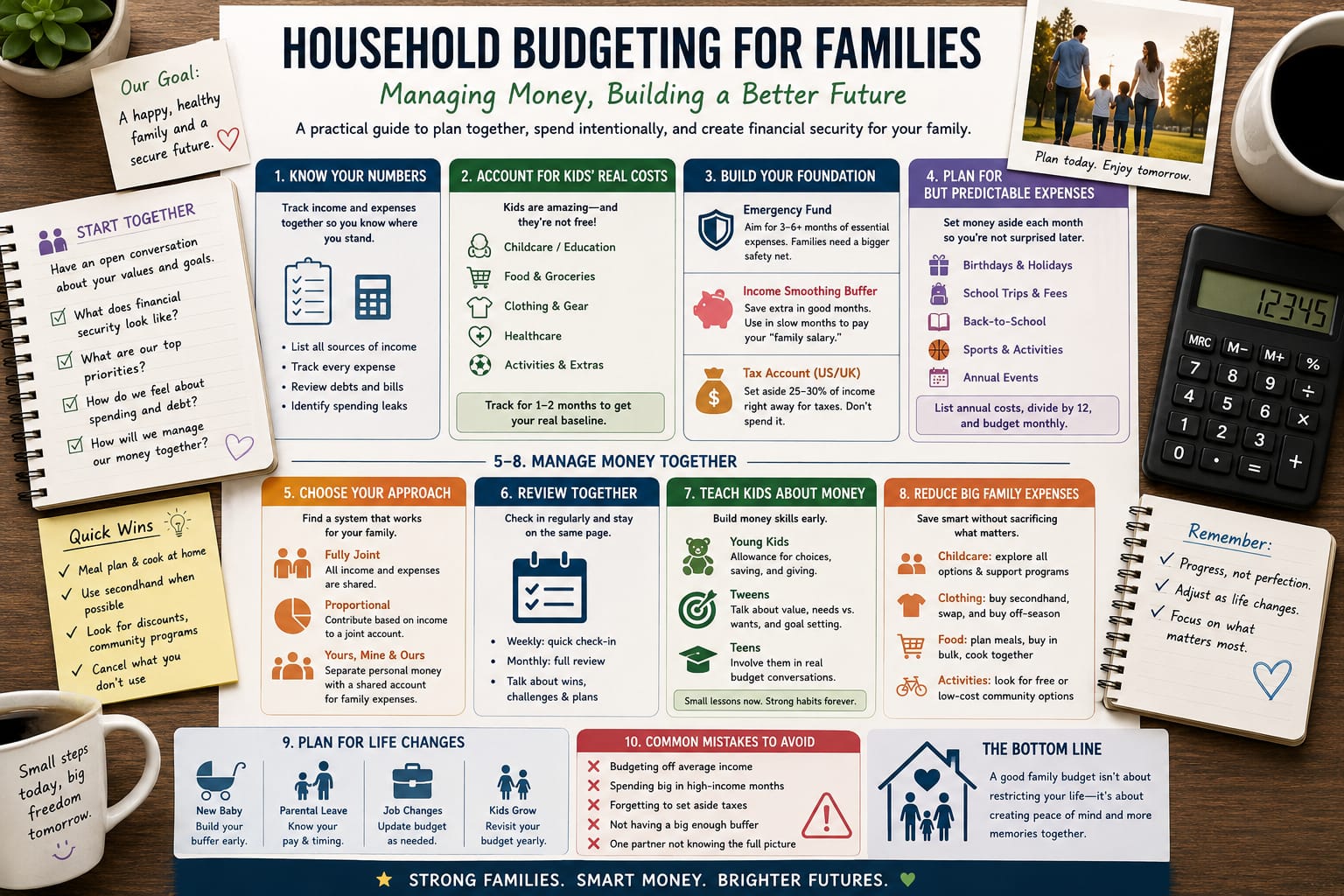
Start With a Joint Financial Conversation
Before building any numbers, couples raising children together benefit enormously from a clear, honest conversation about financial values and priorities. This includes discussing:
What does financial security mean to each of you, specifically?
What are your shared priorities: private school, travel, a larger home, early retirement, or something else entirely?
How comfortable is each of you with debt, risk, and spending on non-essentials?
Will finances be fully combined, kept separate with shared expense contributions, or some hybrid approach?
Skipping this conversation and jumping straight to spreadsheets often leads to a budget that looks reasonable on paper but does not actually reflect both partners’ genuine priorities, making it far less likely to stick long-term.
Account for the Real Cost of Raising Children
Childcare, food, clothing, healthcare, education, and activities all add substantial cost to a household budget, and many new parents underestimate the total considerably. Common categories to plan for include:
Childcare or nursery costs, often one of the largest expenses for families with young children, particularly where both parents work outside the home.
Clothing and gear, which needs frequent replacement as children grow, though secondhand options can meaningfully reduce this cost.
Healthcare costs, including routine checkups, unexpected illnesses, and any specialist care needs.
Education-related costs, including school supplies, uniforms, extracurricular activities, and potentially private school or tutoring.
Food, which typically increases significantly as children grow, particularly during teenage years.
Rather than guessing, track actual child-related spending for a month or two if you have not already, to get a realistic baseline rather than relying on generic estimates that may not reflect your specific circumstances and location.
Build a Family Emergency Fund That Reflects Higher Stakes
Families generally benefit from a larger emergency fund than individuals or couples without children, given the additional financial dependents and the higher cost of potential disruptions, like a period of reduced income during parental leave or an unexpected medical need for a child.
Many financial guides suggest aiming toward the higher end of the typical three-to-six-month expense range, or even beyond, for families, particularly if one partner’s income is significantly larger or if childcare arrangements would be difficult to unwind and rebuild quickly if needed.
Plan for Predictable But Irregular Costs
Family life includes many expenses that are entirely predictable in the long run but do not happen every single month: birthdays, holiday gifts, school trips, new sports equipment as children grow, and annual events like back-to-school shopping.
List these anticipated costs over a full year, add them up, and divide by twelve to create a consistent monthly set-aside amount. This prevents these predictable but irregular costs from repeatedly feeling like unexpected financial shocks that derail an otherwise stable monthly budget.
Decide How to Structure Shared Finances
Couples raising children together typically choose from a few common structures, each with genuine advantages depending on personal preference and circumstances.
Fully joint finances. All income goes into shared accounts, and all expenses, including personal discretionary spending, come from the same pool. This offers maximum transparency and simplicity but requires strong alignment on spending priorities.
Proportional contribution to shared expenses. Each partner contributes to a joint account for shared household expenses, often proportional to income, while maintaining separate personal accounts for individual discretionary spending. This preserves some financial independence while still covering shared family costs collaboratively.
A hybrid “yours, mine, and ours” approach. Similar to proportional contribution, but often with clearer categorization of exactly which expenses are considered joint versus individual.
There is no universally correct structure. The right choice depends on both partners’ comfort levels, income differences, and communication styles, and what matters most is that both partners genuinely understand and agree with whatever structure is chosen.
Involve Both Partners in Ongoing Budget Reviews
A common pattern in many households is one partner taking primary responsibility for day-to-day budgeting and bill payments, while the other has less visibility into the overall financial picture. While this division of labor is often practical, it can create problems if only one partner truly understands the full financial situation.
Schedule a regular, brief joint budget review, whether weekly or monthly, where both partners look at the numbers together, discuss any upcoming large expenses, and confirm alignment on financial goals. This prevents surprises and ensures both partners feel genuinely informed and involved, regardless of who handles the daily logistics.
Teach Children Age-Appropriate Money Habits
Family budgeting also presents a natural opportunity to teach children healthy money habits from an early age, which can meaningfully influence their own financial behavior as adults.
Young children can learn basic concepts through a simple allowance system tied to age-appropriate chores, along with basic saving and spending choices for their own small amounts of money.
Older children and teenagers can be involved in slightly more advanced conversations, such as understanding the cost of certain family activities, learning to compare prices, or managing a slightly larger allowance that requires planning across a longer period.
Consider involving teenagers in some real budget conversations, such as discussing the cost of a family holiday and involving them in decisions about how to allocate a fixed spending amount during the trip, which builds practical decision-making skills.
Reduce Common Family Expense Categories Without Sacrificing Quality
Childcare. Explore all available options, including flexible work arrangements, shared nanny arrangements with another family, or eligibility for any government childcare support programs available in your specific location.
Clothing and gear. Secondhand children’s clothing and equipment, clothing swaps with other families, and buying slightly ahead of season during sales can meaningfully reduce this rapidly recurring cost category.
Food. Meal planning around family preferences and batch cooking can reduce both cost and the temptation toward expensive convenience food during busy weekday evenings.
Activities and extracurriculars. Look for community programs, school-based activities, or shared carpooling arrangements that reduce both cost and time burden compared to more expensive private options, particularly for younger children still exploring different interests.
Plan for Parental Leave and Income Changes
If you are expecting a new child, plan financially for the specific parental leave policies available to you, whether through an employer or government program, well before the leave period begins. This often means building a larger buffer in advance to cover any gap between full income and whatever leave pay is available, along with the added costs that typically arrive with a new baby.
Similarly, if one partner plans to reduce working hours or step away from paid work for a period to focus on childcare, plan this transition well in advance financially, adjusting the household budget gradually rather than facing an abrupt income change without preparation.
Revisit the Family Budget as Children Grow
A family budget built when children are very young will not reflect reality once they reach school age, and it will change again during teenage years. Costs shift considerably: childcare expenses often decrease once children start school, while food, activities, and eventually education-related costs tend to increase. Build a habit of revisiting the full family budget at least annually, or whenever a significant change occurs, like a child starting school or reaching a new stage that shifts spending patterns meaningfully.
Final Thoughts
Household budgeting for families builds on the same core principles as individual budgeting, honest tracking, clear priorities, and a realistic plan, while adding the complexity of shared decision-making and the substantial additional costs that come with raising children. Open, ongoing communication between partners, a larger emergency fund reflecting higher stakes, and deliberate planning for both predictable childcare costs and less frequent expenses like birthdays and school trips all contribute to a family budget that genuinely works, rather than one that looks good on paper but falls apart under the real complexity of family life.
Frequently Asked Questions
How much bigger should a family emergency fund be compared to an individual’s? Many financial guides suggest aiming toward the higher end of the typical three-to-six-month range or beyond, given the additional dependents and potential disruptions unique to family circumstances.
Should couples combine all their finances after having children? There is no universally correct approach. Fully joint finances, proportional contributions with separate personal accounts, or a hybrid structure can all work well, depending on both partners’ preferences and comfort levels.
At what age should children start learning about money? Basic concepts like saving and simple spending choices can be introduced from a young age, often through a simple allowance system, with more advanced budgeting concepts introduced gradually as children grow into their teenage years.
How often should a family budget be reviewed? A brief joint review monthly is a good general habit, with a fuller reassessment of the entire budget at least annually, or whenever a significant life change occurs, such as a child starting school.
Household Budgeting for Families: Managing Money With Kids

Leave a Reply